While browsing real estate listings, you have probably come across mentions like F1, F2, or F3 without always knowing what distinguishes them. These codes refer to the number of main rooms in a dwelling, not its area or standard. The letter and the number that follows are enough to describe the composition of an apartment, but several subtleties deserve attention.
Main room: the criterion that most listings do not explain
Before counting the rooms, it is important to know what counts as a room. Only the main rooms are included in the count: living room, lounge, bedrooms, dining room. The kitchen, bathroom, and toilets are never included in the number.
Further reading : How to Watch an NBA Game Streaming: Legal Solutions and Reliable Alternatives
This is not just a convention. To be classified as a main room, a space must measure at least 9 m² with a ceiling height of at least 2.20 m. A low mezzanine or a 7 m² alcove does not turn an F2 into an F3, even if a less scrupulous real estate agent might imply otherwise.
Understanding what an F1, F2, or F3 apartment is starts with this minimum area rule, which explains many discrepancies between a listing’s description and the reality of the visit.
Related reading : Understanding Animal Welfare: Issues, Rights, and Protection of Animals Today

F, T, or P: three letters for the same thing
You may have noticed that some listings write T2 and others F2 for the same type of dwelling? F, T, and P refer to exactly the same calculation method. F stands for “function,” T for “type,” and P for “room.” The number that follows is always the number of main rooms.
Usage varies by region and the habits of professionals. The letter T dominates in recent listings. The letter F remains common in everyday language and among notaries. The abbreviation P still appears occasionally in some southern cities, like Marseille.
An F3, a T3, and a P3 all correspond to an apartment with three main rooms, typically a living room and two bedrooms, plus ancillary spaces (kitchen, bathroom, toilets).
F1, F2, F3: concrete composition of each type of apartment
The F1: a single living space
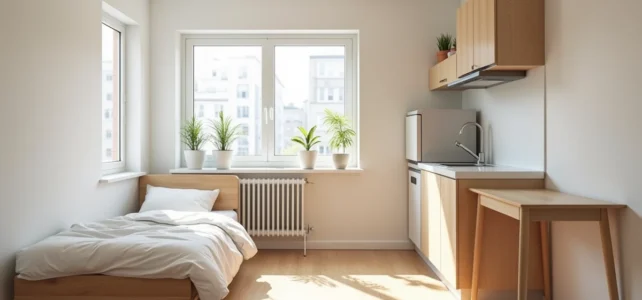
An F1 consists of a unique main room that serves as both a living room and a bedroom. The kitchen is separate from this room, even if it can be very small. A separate kitchen distinguishes the F1 from a studio, where the living space and kitchenette share the same room.
This difference may seem trivial on paper. In practice, it changes daily life: cooking odors, furniture arrangement, sense of space. An F1 with a closed kitchen offers better separation of uses than a studio of equivalent size.
The F2: a living room and a bedroom
The F2 includes two main rooms, most often a living room and an independent bedroom, with a door that closes. This is the preferred format for couples or people who work from home and need to isolate their resting space.
The kitchen can be open to the living room or closed. An open kitchen does not create an additional room: it remains a functional space that does not count in the total.
The F3: two separate bedrooms
Three main rooms: a living room and two distinct bedrooms. The F3 is suitable for small families or anyone who wants a dedicated office in addition to their bedroom.
A often overlooked point: in an F3, both bedrooms must each meet the threshold of 9 m² and 2.20 m ceiling height to be counted. A dwelling advertised as F3 with an “8 m² bedroom” is actually an F2 with an extra space.
Studio, F1 bis, duplex: cases that create confusion
Several terms revolve around this classification and blur the reading of listings. Here are the distinctions to remember:
- The studio resembles the F1 but the kitchen is not separate. The living space and kitchenette form a single area. The bathroom remains independent.
- The F1 bis (or T1 bis) refers to an F1 whose main room has a recess, alcove, or mezzanine large enough to accommodate a sleeping area, without constituting a closed room that meets the area criteria.
- The duplex or triplex describes the distribution over two or three levels, not the number of rooms. A duplex can be an F2, F3, or F5 depending on its configuration.

Area and number of rooms: two complementary pieces of information to cross-reference
The number of rooms says nothing about the total area. An F2 can measure 30 m² in an old Parisian building or exceed this area in a recent construction on the outskirts.
When searching for housing, cross-referencing the type (F1, F2, F3) with the living area allows for a better assessment of the actual size of each room. A small F3 may offer less comfortable bedrooms than a spacious F2.
For a rental investment, this distinction has a direct impact on the rent per square meter and the profile of tenants. A well-designed F1 in a student area rents quickly. A compact F3 in the same area may struggle to find tenants, as families also seek space.
The classification of F1, F2, or F3 remains a useful reference for filtering listings and comparing properties. It does not replace the visit, where one checks that each room meets the minimum area criteria and that the layout corresponds to actual use. The number after the letter provides direction, while the plan and square meters provide the answer.