The automotive maintenance budget has changed in nature over the past two years. The rise in energy costs and inflation on spare parts are pushing a growing number of drivers to postpone operations deemed secondary, to prioritize entry-level parts, or to choose between mechanical and aesthetic considerations. This context alters the way vehicles are selected, equipped, and how ongoing expenses are planned.
Automotive maintenance and inflation: what has really changed since 2023
Several analyses from the after-sales sector document a clear trend: drivers are shifting towards minimal maintenance. Oil changes are respected, technical inspections are honored, but interior cleaning, body treatment, or early replacement of consumables are often deferred.
You may also like : Everything You Need to Know About Counterfeiting at Sarenza: Investigation and Expert Opinions
This postponement does not only concern those on a tight budget. It also affects owners of recent vehicles who extend the intervals between visits to the workshop beyond the manufacturer’s recommendations. The long-term risk concerns resale value and safety, two areas where short-term savings can be costly.
On the Auto Moto Pneu automotive guide, the technical sheets by model allow for estimating the actual cost of regular maintenance even before purchase, which avoids unpleasant surprises once the vehicle is in hand.
You may also like : Everything You Need to Know About the American Bully and Exotic Bully: A Guide to Choosing Your Puppy

Independent garages or dealerships: where to maintain your vehicle based on mileage
Reports from the FNA and the Cetelem Automobile Observatory indicate a clear increase in independent garages and auto centers for simple operations: oil changes, brakes, tires. Drivers find a better balance between price, proximity, and speed there.
However, the choice of the right maintenance channel depends on the specific context of each vehicle.
- During the manufacturer’s warranty period, going through the authorized network often remains a condition for maintaining that warranty, even if European law theoretically allows for the use of an independent under certain traceability conditions for parts.
- Beyond the warranty, an independent garage or auto center offers hourly rates that can be cut in half, with equivalent quality parts for regular maintenance (filters, brake pads, shock absorbers).
- For heavy interventions (gearbox, onboard electronics, recalibration of ADAS sensors), the manufacturer’s diagnostics remain difficult to replace, especially on recent models filled with proprietary software.
The digital maintenance logbook, increasingly widespread, facilitates tracking regardless of the chosen provider. However, its rigorous maintenance directly affects the depreciation at resale.
Tire pressure and brake wear: two underestimated safety issues in daily life
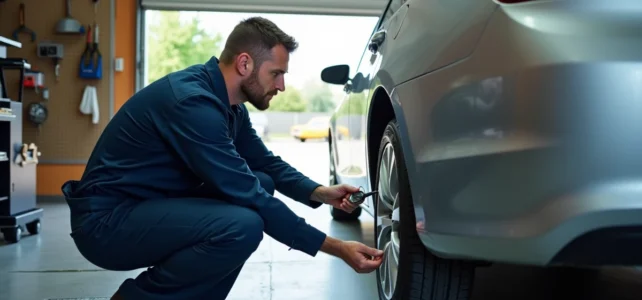
Classic maintenance checklists all mention checking tires and brakes. In practice, tire pressure is only checked a few times a year by the majority of drivers, while inappropriate pressure degrades braking, increases fuel consumption, and accelerates uneven tire wear.
Under-inflation remains the most common problem. A visually correct tire may have lost enough pressure to alter the vehicle’s behavior in curves or on wet surfaces. TPMS sensors, mandatory on new vehicles for several years, alert in case of significant drops, but not in cases of moderate and gradual under-inflation.
Brakes: beyond the thickness of the pads
Pad wear is the most monitored criterion in the workshop. Brake fluid, however, is often forgotten. Yet old brake fluid absorbs moisture and loses effectiveness, with a risk of vapor lock under intense use (downhill driving, heavy loads). Replacement is recommended according to an interval defined by the manufacturer, but is rarely adhered to by individuals.

Choosing a vehicle while considering maintenance costs: the criteria that technical sheets do not show
The purchase price captures all the attention. The total cost of ownership over five years, however, largely depends on factors rarely compared before signing: the price of model-specific wear parts, the interval between two services, the availability of parts in the independent market, and the complexity of onboard electronics.
A vehicle whose parts are only distributed through the manufacturer’s network will mechanically cost more to maintain than a widely distributed model whose consumables are available at auto centers. The availability of parts in the independent market weighs as much as the catalog price.
Engine type and regular maintenance
Electric motors reduce the number of mechanical operations (no oil changes, no timing belt, brake wear slowed by energy recovery). Field reports diverge on this point regarding the actual long-term costs, particularly concerning the replacement of the traction battery out of warranty, an item whose price remains high and variable depending on the brands.
Plug-in hybrids combine the constraints of both worlds: maintenance of the thermal engine and monitoring of the electrical system. The gain in use heavily depends on the driving profile and the actual percentage of kilometers driven in electric mode.
Maintaining a vehicle is not just a checklist of tasks to tick off. The choice of provider, the timing of part replacement, the type of engine chosen at purchase, and the maintenance logbook’s upkeep form a set of interconnected decisions, the impact of which is measured in daily safety as well as in the vehicle’s residual value.