A birthday is approaching, a family celebration is being prepared, and the question arises again: what gift to give a child that won’t end up forgotten at the back of a closet? When the chosen item also serves to decorate the room, it gains in longevity and utility. However, it is essential to find the right balance between aesthetics, practicality, and adaptation to often limited space. A few concrete guidelines can help make a relevant choice, far from unnecessary accumulation.
Decorative gift for a child’s room: the criteria that really matter
Have you noticed that a child’s room fills up quickly? Two stuffed animals, three frames, and a teepee later, the floor has disappeared. The first reflex before buying a decorative gift is to assess the actual available space.
Read also : How to Choose the Perfect Hairstyle for Your Little Girl: Original and Trendy Ideas
A free wall of less than one square meter can accommodate a growth chart, a wall shelf, or a framed poster. A corner on the floor can hold a storage basket. But an object placed in the middle of the room, like a miniature armchair, is only suitable if the room exceeds a certain size.
The second filter concerns the dual function. A decorative gift that is useful on a daily basis will never be stored in a box. A night light is used every evening. A fabric basket stores books or stuffed animals. A wall hook in the shape of an animal organizes clothes while decorating. This type of object lasts through the years because it has a concrete function.
Related reading : Ideas and Inspirations for Authentic and Warm Moroccan Decor in Your Home
Parents looking to refresh their child’s room decor with carefully chosen pieces can discover the La Petite Emma website, which offers a selection focused on both decorative and functional items.
The third point is material durability. A solid wood frame withstands the handling of a three-year-old. A laminated poster can be wiped clean with a sponge. A fragile fine ceramic object, placed on a low shelf, has a limited lifespan in an environment where everything is touched, thrown, and chewed on.
Child decor trends: what has changed in parents’ choices
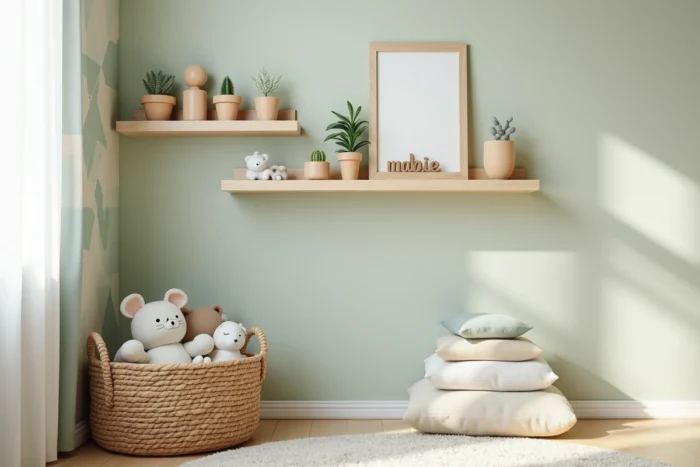
Recent selections of decorative gifts for children show a clear shift. The purely visual approach is giving way to a broader sensory dimension. Soft materials, natural textures, and soothing colors are taking precedence over bright colors.
Washed linen, organic cotton, raw or water-painted wood are gradually replacing colorful plastic. This change is not just a passing trend. It responds to a growing expectation around authenticity and responsible manufacturing.
Personalization of decorative gifts for children
Why does this choice attract so much? A name embroidered on a cushion or engraved on a growth chart transforms a generic object into a unique piece. The child becomes attached to it. Parents can more easily integrate it into an existing decor because the personalized gift was designed for that specific child.
A personalized gift fits better than a generic object into an already arranged space. Personalization can involve the name, color, and sometimes size. It often entails a longer production time, which should be anticipated before the event date.
Made in France as a selection criterion
The market for gift ideas for children is moving towards more explicit ethical criteria. Some selection sites highlight made in France and zero waste as trend markers. This positioning corresponds to a real demand: giving an object whose origin is known reassures about its quality and manufacturing conditions.
Decorative gift ideas suitable for small spaces
In a room of less than ten square meters, every object must justify its presence. Here are categories of decorative gifts that work without cluttering:
- Wall decoration: posters, photo frames, string lights, repositionable stickers. They occupy no floor space and can be easily changed as the child grows.
- Decorative storage: wicker baskets, printed fabric boxes, wall shelves in the shape of a house or cloud. They absorb clutter while adding character to the room.
- Ambient lighting: silicone night lights, wooden table lamps, low-energy LED garlands. A night light often replaces a bedside lamp and frees up space on the nightstand.
- Textiles: patterned cushions, cotton throws, small rugs. They warm the atmosphere without additional furniture.
What distinguishes a good decorative gift from a cumbersome one is its ability to be fixed to the wall or stored in an existing piece of furniture. An object that requires its own support or floor space poses a problem in a small room.
Choosing a durable decorative gift according to the child’s age
A decorative gift for a six-month-old baby does not meet the same constraints as a gift for a seven-year-old child. The age range determines safety, aesthetics, and the longevity of the object.
For toddlers, safety is the priority. No small detachable parts, no uncertified paint, no sharp edges. Hanging mobiles, felt wall art, or animal-shaped cushions meet these criteria.
From the age of three or four, the child begins to express their preferences. They love dinosaurs, stars, cars. A decorative gift that incorporates their favorite universe is more likely to remain on display. An illustrated poster, a set of decorative figurines, or a themed hook are well-suited for this age group.
After six years, tastes evolve quickly. It is better to favor neutral or easily replaceable objects. A natural wood shelf, a round mirror, a simple storage basket: these pieces can transition through phases without appearing dated.
The most relevant decorative gift remains one that combines practical use, solid construction, and aesthetics compatible with the existing room. Objects that meet these three conditions rarely end up at the bottom of a drawer.