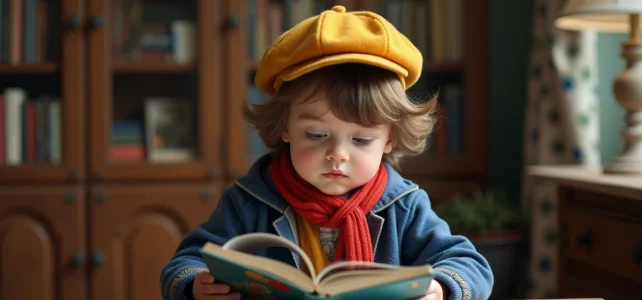
1949. British bookstores discover a new character, Noddy, created by Enid Blyton. The words, in their original version, fix nothing: neither grammatical gender, nor sexual identity, nor predefined codes. Very quickly, as the success spreads and adaptations multiply, the boundaries become blurred. Depending on the countries, translations, and broadcasting channels, the little hero sometimes dons a masculine costume, sometimes embraces an assumed neutrality. It all depends on the spirit of the times, public expectations, or sometimes, simply, an editorial choice. This oscillation, far from being a detail, questions the way we construct and perceive child figures. Must we absolutely assign a gender to the heroes of the very young? And above all, what does this ambiguity say about our relationship with childhood and identity?
When the Gender of Fictional Characters Becomes a Fascinating Mystery
Let’s take a closer look at these characters who, from their appearance, escape the rule of “neither quite girl nor quite boy.” Noddy is part of this select circle. A bit like Tchoupi, whose story never specifies gender, or Barbapapa, a plant figure that slips between definitions. This blur is no accident: it is a choice, designed to open the door to all children, without barriers or labels. Originally, the creators of Noddy emphasized this neutrality: allowing everyone to identify without being limited by stereotypes or imposed gender.
Further reading : How to Choose the Perfect Hairstyle for Your Little Girl: Original and Trendy Ideas
And Noddy is not an isolated case. In animated universes, many heroes blur the lines. Take Road Runner, the geocuckoo who defies logic; it is neither a “he” nor a “she” that we remember, but rather the image of a vehicle impossible to catch. The same logic applies to Gary, SpongeBob’s snail, whose meowing and unique personality defy usual categories. Mickey, on the other hand, transcends boundaries: his white gloves, which have become an emblem, place him beyond genders, at the crossroads of myth and collective symbol.
Institutions are not left behind. The High Council for Equality highlights mixed representation in children’s media and praises initiatives that refuse confinement. Noddy, in his version most faithful to Enid Blyton’s spirit, offers a space where every child can invent their own relationship with the hero. Far from freezing identities, this neutrality paves the way for a diversity of imaginations. For those who want to delve deeper, the complete analysis on noddy girl or boy sheds light on the behind-the-scenes of this approach.
You may also like : How to Write a Consultant CV that Stands Out in the Market
Here are some figures that embody this approach to ambiguity and openness:
- Noddy: an identity embraced as undefined, so that every child can find themselves in it.
- Tchoupi: the little penguin, never assigned, who traverses stories without a label.
- Barbapapa: a plant creature, whose appearance and nature defy any human classification.
Noddy: What Do His Creators Really Say About His Identity?
Since the first publication, Enid Blyton’s ambition remains clear: to bring to life a hero capable of speaking to everyone. The first versions, whether English or French, deliberately leave the field open. Noddy has no stereotypical clothing, no gendered behaviors, no assigned role. What matters are his human qualities: kindness, curiosity, a taste for adventure. Nothing else.
On the side of Hachette editions, the guiding principle does not change: Noddy remains a versatile character, rooted in a town, Toyland, where diversity reigns. His friends? Pumpkin, Clever, Sneaky, Bibi… Here again, everything is done to sketch a world where universality prevails over categorization. Cartoons, toys, video games: no adaptation has ever made a definitive cut. The “mystery” is part of the hero’s DNA.
The available documents are unequivocal. This blur is not an absence of choice, but rather a decision embraced by the authors and publishers. The goal? To offer every child the possibility of recognizing themselves, without a restrictive framework. This editorial positioning, supported by Hachette in France, is part of a desire for inclusion and openness. For those wishing to understand the mechanics of this strategy, the file “noddy girl or boy” dissects in detail the intention behind this claimed neutrality.
The Influence of a Genderless Hero on Children’s Imagination and Emotions
Noddy, a genderless figure, disrupts the habits of children’s storytelling. Here, no label. The child, regardless of their identity or questions, can freely project themselves into the adventures of Toyland. Noddy’s personality, trajectory, choices: that is what matters. This latitude allows for broad identification, without constraint.
Institutional recommendations go in this direction. The High Council for Equality encourages mixed representation in youth programs to support the evolution of mentalities. Noddy, neither boy nor girl, thus emerges as an accessible presence, a unifying hero. Specialists in child psychology observe that these neutral characters stimulate empathy, promote cooperation, and nurture tolerance. They also allow the child to cultivate their own emotional autonomy.
The playground testifies to this: Noddy brings people together, becomes an anchor point, a collective reference where everyone can express themselves and dream. Roles are no longer fixed, but fluid, like a series that leaves room for everyone’s experience. The mix, advocated by institutions, translates here into a realm of imagination and sharing, concrete and vibrant. Noddy is no longer just a hero: he becomes the flexible and caring mirror of a generation that, too, invents its own benchmarks.