
A pack of cigarettes purchased in Switzerland costs significantly more than in France, and the gap is not narrowing. For a French smoker crossing the border or a curious traveler, the conversion to euros often brings surprises. Understanding what determines the price of tobacco in Switzerland allows for anticipating the actual bill in 2026.
Swiss tobacco taxation: a system different from France
You may have already noticed that a pack of cigarettes costs more in Geneva than in Annecy, even though Switzerland is often perceived as less strict on tobacco? The paradox is explained by the high cost of living in Switzerland and a particular tax structure.
Recommended read : What to do if the leaves of the oleander turn brown and dry in summer?
In Switzerland, the price of tobacco depends on two distinct mechanisms. The first is the specific tobacco excise duties, set by the Confederation. The second is VAT, which has a normal rate of 8.1% since January 2024. This rate is much lower than that practiced in France, but it does not compensate for the high level of prices excluding tax.
According to the Tobacco Control Scale 2025 report, Switzerland ranks second to last among 37 European countries in the fight against smoking. Its tobacco taxation remains lower than that of its neighbors, and control measures are less strict. This positioning slows the massive and close increases observed in France, where the government schedules regular hikes.
Read also : How to find the new Streamonsport address in 2026 to watch sports streaming
To anticipate the Swiss cigarette price in euros in 2026, it is necessary to monitor two levers: the evolution of Swiss excise duties (which change slowly) and the Swiss franc/euro exchange rate (which fluctuates more).
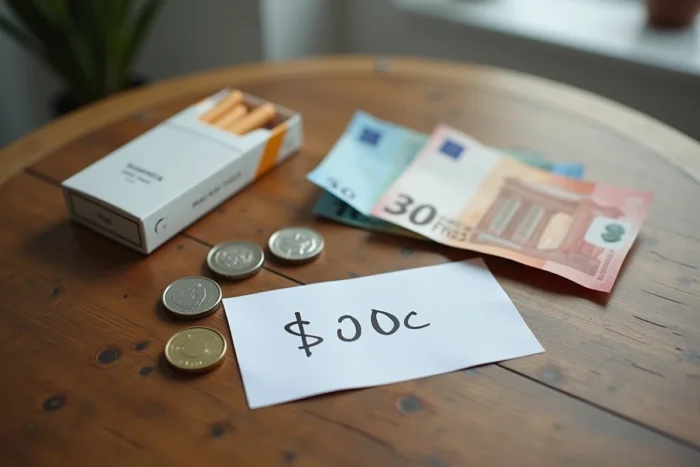
Swiss cigarette price in euros: what a buyer actually pays in 2026
Price projections in euros for Swiss tobacco are based on estimates for travelers, not on an official converted grid. Manufacturers set their prices in Swiss francs. The conversion to euros depends on the current exchange rate.
The CHF/EUR exchange rate amplifies or mitigates the price gap between Switzerland and France. A strong Swiss franc mechanically increases the price for a buyer thinking in euros. Conversely, a weakening of the franc may give the illusion of a decrease, while the price in local currency has not changed.
In practice, a pack of common brand cigarettes in Switzerland clearly exceeds French prices. The gap amounts to several euros per pack. For a daily smoker, the difference over a month represents a significant budget.
What online comparators do not always specify
Websites displaying a Swiss cigarette price in euros often use a fixed exchange rate from a given date. The actual price at the Swiss tobacco shop may differ by several tens of cents depending on the time of purchase. Checking the CHF/EUR rate on the same day remains the only reliable way to estimate one’s expenditure.
Increase in tobacco prices in France and Swiss inflation: two distinct dynamics
In France, the price of a pack of cigarettes has increased three times since the beginning of 2026. The increases in January, February, and March affected more than 500 references, with increases ranging from 10 to 80 cents depending on the brands. The average price of a pack of 20 cigarettes is now around 13.50 euros for the best-selling references.
In Switzerland, the pace is different. Price increases are less frequent and less predictable than in France. The federal government does not follow a bi-monthly revision schedule like the French administration. Price adjustments depend more on manufacturers’ decisions and the occasional evolution of taxation.
Three factors separate the two markets:
- France applies a scheduled increase policy to discourage consumption, with a transparent tax calendar and regular thresholds.
- Switzerland maintains a structurally lower tobacco taxation, which limits sharp increases but does not prevent a slow progression of prices.
- The Swiss VAT rate (8.1%) has less impact on the final price than the French VAT, but this difference is offset by the overall cost of living in Switzerland.
Buying tobacco in Switzerland by French travelers: limits to know
Crossing the border to buy less taxed tobacco is a common practice in border areas. In 2026, this strategy deserves reevaluation.
The price differential between France and Switzerland has narrowed in recent years. Successive French increases have brought prices closer together, but Swiss tobacco remains generally more expensive in absolute value (in euros) due to the local cost of living. The interest in cross-border purchases thus depends on the chosen brand and the exchange rate at the time of purchase.
Travelers must also consider customs allowances. Upon returning to France, the quantity of tobacco imported without additional duties is regulated. Exceeding the authorized thresholds exposes one to taxation upon entry that nullifies any savings.
- Compare prices in Swiss francs, then convert at the current rate before traveling.
- Take into account the cost of the trip (fuel, tolls, time) in the calculation of the actual savings.
- Respect customs allowances to avoid a surcharge that erases the expected gain.
Outlook for the Swiss tobacco price converted to euros
Switzerland has not announced any major tax reform on tobacco for 2026. Prices are expected to rise slowly in Swiss francs, without a comparable break to the French increases. The real factor of uncertainty remains the exchange rate: a strengthening of the Swiss franc against the euro could increase the bill for French buyers, even without local increases.
On the French side, the government maintains its trajectory of regular increases. The average price of a pack in France is gradually approaching Swiss levels converted to euros. At this rate, the gap between the two countries could continue to narrow by the end of the year.
For a smoker or traveler tracking the Swiss cigarette price in euros, the decisive variable in 2026 is not Swiss taxation (stable), but the monetary parity between the franc and the euro.