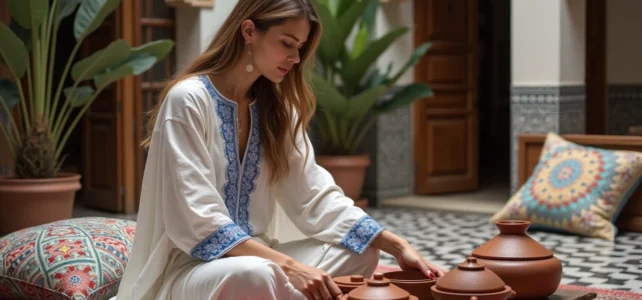
You don’t tame Moroccan decor by copying a Pinterest photo or accumulating travel souvenirs. Here, craftsmanship asserts itself, balancing centuries-old traditions with modern impulses. The past converses with the present, and clean lines meet the artisan’s hand, far from frozen clichés.
Custom-made design bursts onto the scene, handmade items regain the spotlight. The unique piece, once reserved for a select few, now stands as a reliable marker for those seeking authenticity in their living spaces.
Related reading : How to Choose the Perfect Hairstyle for Your Little Girl: Original and Trendy Ideas
Why is Moroccan decor so appealing in our interiors today?
Moroccan decor carves its path in today’s homes thanks to its skillful blend of warmth and refinement. Its secret? Engaging raw materials, handcrafted objects that carry traditions passed down and renewed. The warm colors, ochre, deep red, Majorelle blue, palm green, inject friendliness and visual density, far from mere anecdote or folklore.
Far from simple exoticism, this style is rooted in the richness of complex geometric patterns and a subtle dialogue with light. Berber fabrics, handwoven rugs, and leather cushions fill our living rooms and bedrooms, adding relief and softness. Copper or brass lanterns, hammered one by one, diffuse a soft light, while tadelakt and zelliges shape the space with character. In terms of furniture, the carved solid wood emphasizes comfort and conviviality, far from demonstration or ostentation.
Further reading : Gift and Decoration Ideas for Kids: Trends and Inspirations to Discover
Moroccan craftsmanship shines through the plurality of its techniques and materials: weaving, pottery, ceramics, leather. The Maison et Objet fair recently highlighted an entire space dedicated to this craftsmanship, proof of a passion that shows no signs of waning. According to Fleur Vanbésien, this heritage is evolving today, with each object carrying the memory of a territory and a gesture. A living legacy that renews itself without diluting.
Deco Asaiss showcases these inspirations and know-how, emphasizing how Moroccan inspiration transcends mere fashion trends. To give meaning to every interior, Moroccan decor offers some key elements:
- patterns that catch the eye,
- materials crafted with care,
- objects that tell a story.
This approach, contrary to uniformity, restores the place of humanity, memory, and craftsmanship in the home.
Colors, materials, patterns: how to recognize and adopt the essentials of Moroccan style
The Moroccan color palette stands out for its depth and vitality. Majorelle blue, intense red, bright yellow, ochre, palm green, gold, silver: each shade tells a fragment of history, often inspired by the Majorelle Gardens or the Hassan II Mosque. These colors structure the space, infusing that warmth characteristic of Moroccan decor, in touches or bold applications.
Materials and textures: from raw to refined
In the Moroccan universe, the choice of materials is not left to chance. Solid wood (cedar, thuya) carved for low furniture, tadelakt on the walls, zelliges as backsplashes or flooring: each element plays with light and texture. The fabrics reveal their full sensory potential:
- Berber rugs with thick wool,
- soft leather cushions,
- textiles adorned with geometric shapes or arabesques.
These objects, woven or sewn by hand, multiply contrasts and invite touch, encouraging you to settle in and experience the material.
Geometric patterns and cultural influences
Moroccan decor draws from a repertoire of complex geometric patterns, arabesques, and Berber designs. These symbols, borrowed from the medersa Ben Youssef or the Bahia Palace, rhythm the room, playing with perspectives and contrasts. One can imagine a sculpted coffee table, a hammered copper lantern, a graphic black and white rug: each object becomes an expression of Moroccan inspiration and an embraced identity.
The spirit of conviviality is reflected in the layout: low benches, sedari, an accumulation of thick cushions, a space designed around sharing. Moroccan decor is not just a collection of objects; it prioritizes the balance between colors, materials, and patterns to shape a vibrant, unique interior, open to light and memories.
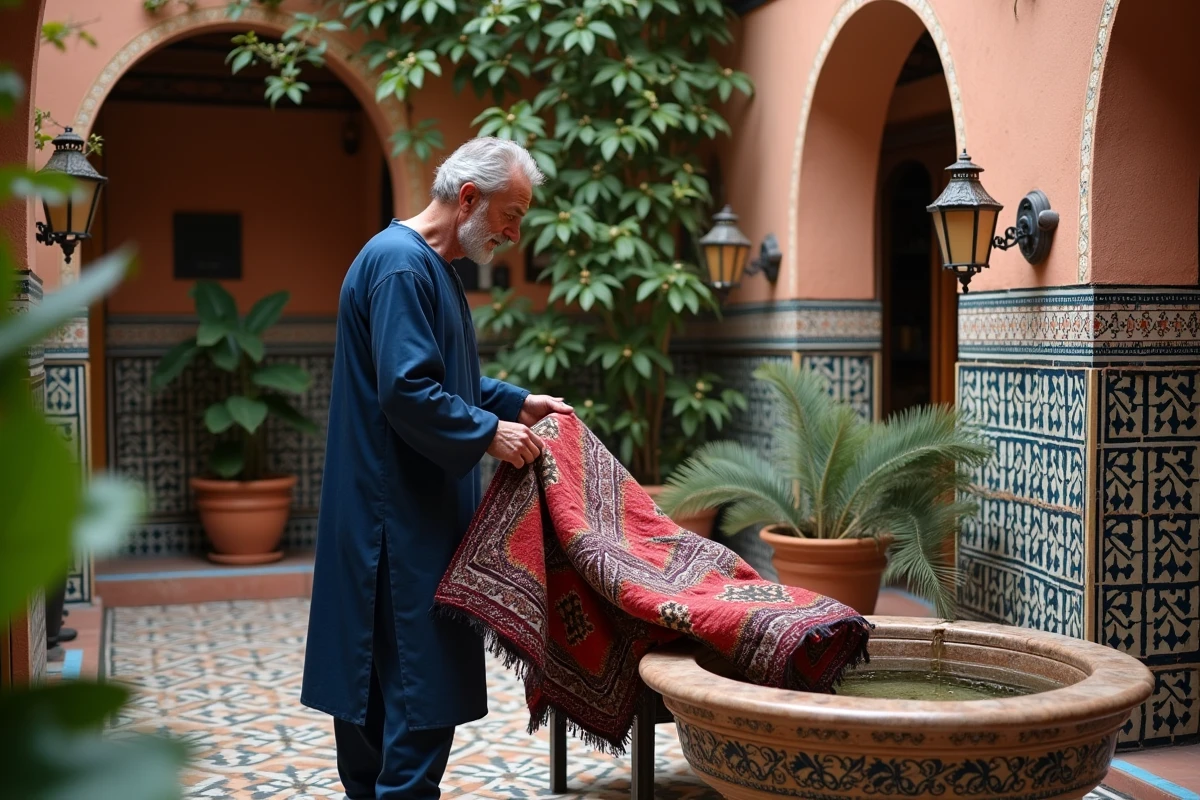
Simple tips to infuse warmth and Moroccan authenticity into your home, room by room
In the living room, focus on an atmosphere designed for exchange: install low benches or sedari, enhance them with leather cushions and a Berber rug. This choice, inspired by the traditional Moroccan living room, promotes relaxation and highlights the artisan’s hand. Place a sculpted solid wood coffee table at the center: it structures the space, accommodating tea, ceramics, or a hammered tray, becoming the focal point of the living room.
In the bedroom, create a cocoon: favor geometric patterned textiles, choose cotton or wool bedding, add a colorful throw, and a plush rug as a bedside mat. For lighting, prefer copper or brass lanterns: their reflections transform the atmosphere, evoking the magic of riads, fountains, and horseshoe arches.
For the entrance or passage areas, a few well-chosen objects are enough to set the tone:
- wrought iron hooks
- straw storage baskets
- sculpted wooden trunk
These details impart a controlled Oriental touch without overwhelming the view. Straw lampshades or palm suspensions, nodding to tradition, blend beautifully with contemporary interiors.
In every room, don’t hesitate to use zellige tiles as backsplashes or murals to energize walls and alcoves. The thoughtful accumulation of patterns, the combination of materials, the coherence of colors: this is the common thread. Moroccan decor shines in the subtle interplay of textures, shades, and light, inviting you to redefine the very notion of hospitality at home.