
In a playground, the choice between a skirt and pants is not a matter of chance. This clothing choice condenses family codes, school norms, and personal affirmation that varies according to age, background, and geographical context. The wearing of skirts by girls remains a topic where individual freedom, social pressure, and recent educational policies intersect.
School Dress Codes and Skirt Choices: What Experiments Show
Skirts are often discussed as symbols, but on the ground, the question arises first in schools. The French experiments with common attire launched starting in the 2024 school year, in about a hundred institutions, highlighted a concrete point: several initiatives explicitly provided for the choice between skirts and pants for girls.
The debate then shifted. The question was no longer just “what does wearing a skirt mean?”, but also “can one choose not to wear one?”. In practice, feedback on this point varies according to the schools and municipalities involved.
The official evaluation published by the DEPP on May 12, 2026, relayed by RFI in September 2026, concludes that the uniform did not significantly reduce harassment or academic difficulties. The Henri-Aigueperse school in Limoges, after two years of trial, reports no real impact on student success.
Practical constraints related to clothing cleaning have also been noted. To delve deeper into the meaning of wearing a skirt on Concept Enfance, it is observed that the symbolic dimensions far exceed the school framework.
Skirt and Gender Norms: A Garment That Doesn’t Say What We Think
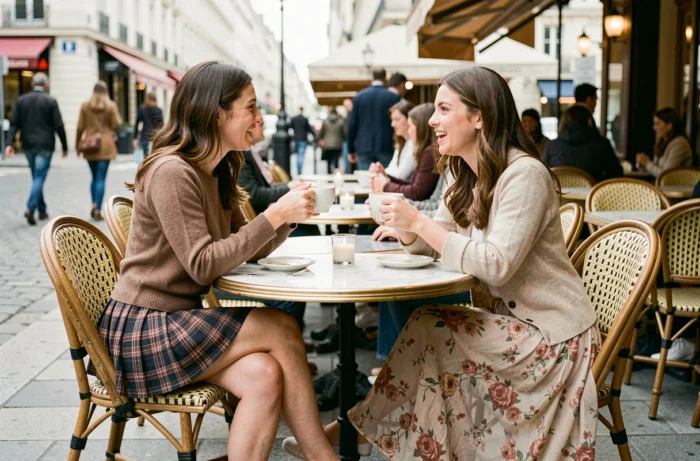
Automatically associating skirts with femininity is a shortcut. Historically, skirts have been worn by men in many cultures (Scottish kilt, Asian sarong, Roman toga). It was only from the 19th century in the West that pants became a strict male marker, relegating skirts to the female wardrobe.
Today, skirts are returning to men’s collections, worn by designers like Thom Browne or Kim Jones at Dior Homme. The garment does not determine the gender identity of the person wearing it. Reducing the wearing of skirts to a question of femininity ignores the mobility of clothing codes across eras.
What the Skirt Expresses Depending on the Context
The same garment changes meaning depending on whether it is worn at the office, in class, or at a party. Here are the main observed contexts:
- In a professional setting, the pencil skirt remains associated with a formal code, sometimes imposed by corporate dress codes. It signals adherence to a dress code more than a personal choice.
- At school, especially among teenagers, the skirt can be an act of affirmation or, conversely, a source of unsolicited remarks. The “skirt day,” organized in some high schools, aims to denounce inequalities and harassment related to appearance.
- In a casual setting, the long skirt, pleated skirt, or mini-skirt falls under an aesthetic choice that does not necessarily carry a reivindicative message.
Harassment and Skirt Wearing in France: The Reality on the Ground
One cannot talk about wearing skirts without addressing the issue of street harassment. Women refrain from wearing skirts in certain public spaces for fear of remarks or inappropriate gestures. This clothing renunciation has been documented for years and remains an active topic in the French public debate.
The mini-skirt particularly crystallizes these tensions. It was a symbol of emancipation in the 1960s when Mary Quant popularized it. However, wearing a mini-skirt in 2026 still exposes one to contradictory judgments: too short for some, too conventional for others.
Why Clothing Freedom Remains a Concrete Issue
The problem does not lie in the garment itself. It lies in the gaze directed at the one who wears it. A skirt is neither an invitation nor a provocation, but the gap between this reality and social perception persists in many contexts.
Initiatives like “skirt day” in schools attempt to bring this point back to the center of the debate. The stated goal: to dissociate clothing from moral judgment and remind that the choice of an outfit is a matter of individual freedom.
Choosing a Skirt: What Really Guides Girls Today
Beyond symbols, wearing a skirt responds to very concrete criteria. Thermal comfort in summer, practicality in daily life, the desire to vary silhouettes: motivations are often more mundane than one might think.
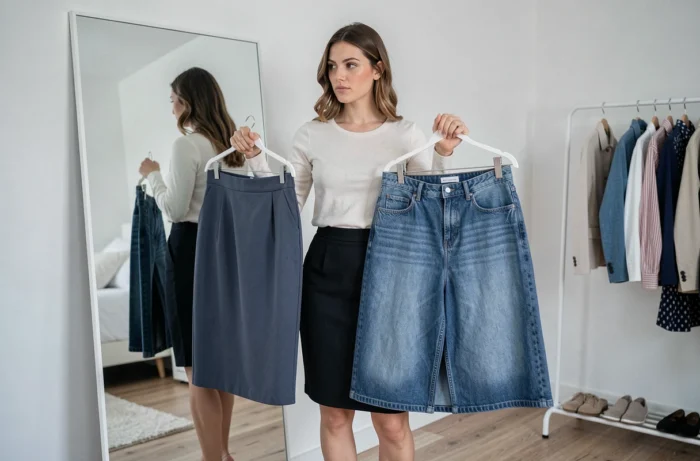
Current fashion offers a range of cuts that allow for wearing a skirt without conforming to a single model of femininity. Midi skirt, cargo skirt, denim skirt, wrap skirt: each cut conveys a different register, from casual to formal.
- The fluid long skirt offers comfort and suits various body shapes without exposing the body to gazes.
- The short skirt remains a conscious choice that requires feeling comfortable in one’s environment.
- The school pleated skirt, repurposed by streetwear fashion, illustrates well how a garment changes meaning when it leaves its original context.
The choice of a skirt primarily reflects a personal relationship with the body and comfort, long before it constitutes a message addressed to others. The girls who wear skirts today do not do so to represent a trend or validate a stereotype. They simply dress, and it is in this banality that the true advancement lies.