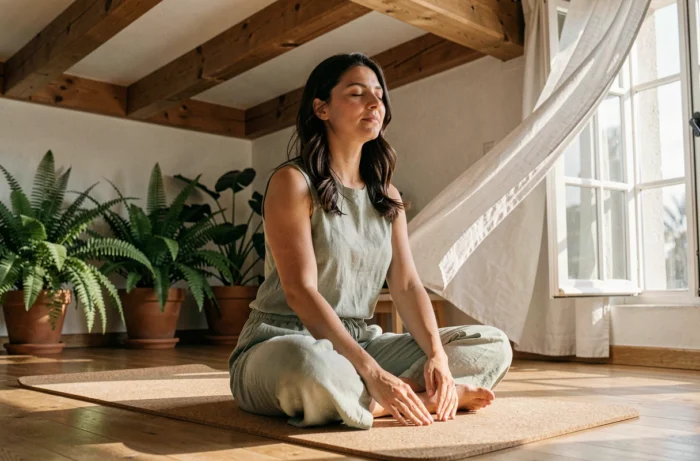
Yoga and mindfulness share a common foundation: deliberately directing attention toward the body, the breath or physical sensations. Supporting your everyday well-being through yoga and mindfulness is about more than simply stacking up poses or meditation sessions. The key is the quality of attention you bring to your practice, not how long you practise or how many sessions you fit in each week.
Evidence for yoga’s effects on stress and the nervous system
Recent systematic reviews show promising results for yoga in reducing perceived stress and affecting certain physiological markers. The caveat is that the certainty of the evidence is often moderate. Several meta-analyses report a high risk of bias in the studies they include, making it difficult to conclude that yoga has a firmly established effect on every measure studied.
In practical terms, controlled breathing and yoga poses probably affect vagal tone and heart rate variability, but protocols differ too much from one study to another to establish a universal “dose”. Mindfulness meditation follows a similar pattern: it appears to have positive effects on anxiety and sleep quality, with the evidence growing stronger but not reaching the level of certainty seen for pharmacological interventions.
This does not invalidate the practice. It means approaching well-being on Les Jardins Du Yoga as one part of an overall healthy lifestyle, not as a standalone treatment. French public health recommendations also place yoga within a broader range of active habits aimed at reducing sedentary behaviour.
Yoga and mindfulness without a regular routine: adapting your practice to real-life demands
Most guides present a daily routine as essential for success. An irregular practice can still be beneficial if you maintain focused attention. The problem is not how often you practise, but how easily your mind wanders during a session.
Someone who practises twice a week while paying close attention to their breathing and proprioceptive sensations is likely to benefit more than someone who mechanically runs through a sequence of poses every day. The body and brain respond to the depth of engagement, not simply the number of hours spent practising.
Three strategies for irregular practitioners
- Link your session to an existing cue (after your morning coffee, before your commute) rather than setting a rigid time. Research on habit formation suggests that this kind of situational cue is more effective at supporting consistency than a calendar reminder.
- Lower your minimum time commitment: five minutes of focused pranayama is better than putting off a thirty-minute session. Alternate nostril breathing (nadi shodhana) and coherent breathing require neither a mat nor special clothing.
- Separate the different elements: practise poses one day, seated meditation another, and mindful breathing on your commute. This modular approach keeps you connected to the practice without requiring one uninterrupted block of time.
Meditation apps: what they offer and where their limits lie
Mindfulness apps have proliferated. One three-month study found that regular users reported less perceived stress and better sleep quality. Frequent app use is not the same as a beneficial practice in itself: these are self-reported associations, not proof of cause and effect.
Nor does a three-month follow-up show that the habit lasts beyond that period. We often see a gap between initial enthusiasm for a digital tool and establishing a lasting practice. An app can be a useful starting point, but it cannot replace in-person instruction that corrects poses, adjusts breathing and identifies physical compensations.
When to seek professional guidance
One issue that is rarely discussed: a guided meditation app cannot detect warning signs. These might include dissociation during a body scan, rising anxiety during slow breathing, or joint pain masked by concentration. Such situations call for a trained teacher or, in some cases, a mental health professional.
Presenting a digital routine as a substitute for qualified guidance raises both ethical and practical concerns. Digital tools can complement support, but they cannot replace it. For people with diagnosed anxiety disorders, unguided meditation may even worsen certain symptoms.
Breathing and poses: the physiological mechanisms at work
Pranayama affects the autonomic nervous system by stimulating the vagus nerve. Slow breathing, at fewer than six cycles per minute, encourages a shift toward the parasympathetic branch. This mechanism helps explain the lower heart rate and sense of calm that can follow just a few minutes of practice.
Yoga poses move the body through a range of positions, stimulating joint and muscle mechanoreceptors. This proprioceptive input enriches the brain’s body map and improves interoceptive awareness—the ability to perceive your own physiological signals. Interoception is the neurological foundation of mindfulness, not an abstract skill.
Some poses also create a sustained fascial stretch (yin yoga), affecting connective tissue and modulating the local inflammatory response. This type of practice is particularly suitable for people who are sedentary or returning to activity, as it involves relatively little muscular effort.
Making yoga part of a less sedentary life without turning it into a dogma
French public health recommendations advise reducing time spent sitting and varying the types of physical activity you do. Yoga fits into this approach as one option among many, complementing walking, strength training and endurance exercise.
The danger is turning your practice into yet another obligation that makes you feel guilty when you miss it. Everyday well-being depends on a flexible routine, not a rigid programme. Alternating yoga, walking and meditation according to how much energy you have that day is a realistic approach.
Yoga and mindfulness offer practical tools for feeling more at home in your body and calming your nervous system. Their effectiveness depends less on how much you practise than on the quality of attention you bring to it. They remain a complement to an active lifestyle and, when needed, appropriate professional support.