
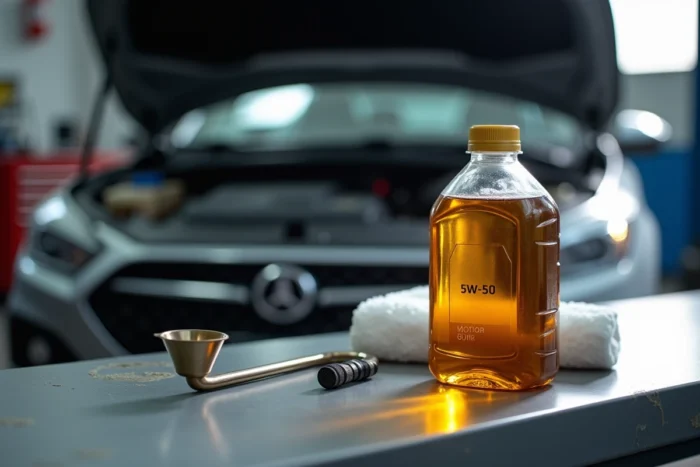
When looking at a 5W50 motor oil container, the numbers on the label promise a wide viscosity range. The “5W” indicates that the oil remains fluid in cold weather. The “50” means it maintains a high thickness at high temperatures. On paper, this combination seems to protect the engine in all conditions. The reality is more nuanced, especially for newer vehicles.
5W50 Viscosity and Pollution Control Systems: A Risky Marriage
Have you ever noticed a check engine light coming on for no apparent reason after an oil change? Choosing an unsuitable oil can sometimes be the cause. Recent gasoline engines come equipped with a gasoline particulate filter (GPF), designed to trap combustion residues. This filter operates optimally with low ash content oils, categorized as “Low SAPS” according to ACEA standards.
Recommended read : Optimize Your Inbox: Practical Tips and Trendy Tools
The 5W50 oils on the market are mostly “full SAPS” or “mid SAPS” formulations. They have been designed for sports engines or older blocks. They do not meet ACEA C5 or C6 standards, which are structured around low viscosity grades like 0W-20, 0W-30, or 5W-30.
Using a 5W50 that does not comply with Cx standards on a gasoline engine equipped with a GPF accelerates filter clogging. Ash accumulates faster, filter regeneration becomes more frequent, and the longevity of the pollution control system decreases. To learn everything about 5W50 motor oil and its concrete effects on a modern engine, one must start from this technical constraint.
You may also like : Teaching and Digital: Solutions to Save Time
Why Manufacturers Exclude 5W50 from Their Recent Recommendations
Since the early 2020s, several manufacturers have tightened their internal specifications. Volkswagen, Audi, BMW, Mercedes, and Toyota now require “fuel economy” oils with low HTHS (High Temperature High Shear), meaning oils that are more fluid when hot.
Let’s take a concrete example. The VW 504.00/507.00 standard requires a specific 5W-30 oil. The BMW Longlife-04 standard does the same. A 5W50 is explicitly excluded from these specifications, unless otherwise stated for competition use.
Why this choice? Modern engines are designed with very tight machining tolerances. The oil channels, bearings, and rings are sized for a specific viscosity. Oil that is too thick when hot generates more internal friction. The engine consumes more fuel to overcome this additional resistance.
Manufacturer Warranty and Out-of-Spec Viscosity
Using a 5W50 in a vehicle whose maintenance manual prescribes a 5W-30 or 0W-20 can pose a legal issue. In the event of engine failure, the manufacturer may invoke non-compliance with its recommendations to deny warranty coverage. Checking the manufacturer’s standard before any oil change remains the simplest precaution.
5W50 Oil on Sports or Older Engines: Cases Where It Justifies Use
Not all engines are subject to these restrictions. The 5W50 retains real technical relevance in certain specific situations:
- Atmospheric or turbo engines from the 1990-2010 era, designed for high viscosity oils, with wider machining tolerances and no particulate filter.
- Engines subjected to extreme temperatures in sports use (track, rally), where thermal stability at high temperatures protects against oil film breakdown.
- High-mileage vehicles whose mechanical clearances have widened with wear, for which a thicker oil partially compensates for these clearances and reduces oil consumption.
Synthetic 5W50 offers superior thermal protection compared to mineral oils in these contexts. Its synthetic base resists oxidation better and maintains its lubricating properties longer under stress.

5W50 or 5W30 Motor Oil: Concrete Selection Criteria
The choice between a 5W50 and a 5W30 is not random. Several technical criteria help make the decision.
- The manufacturer’s recommendation, stated in the maintenance manual or the vehicle’s technical sheet, takes precedence over any other consideration.
- The presence of a gasoline particulate filter (GPF) or diesel particulate filter (FAP) directs towards low viscosity oils compliant with ACEA C5/C6 standards.
- The age and mileage of the engine: a recent block with low mileage has no benefit from receiving a thicker oil than specified.
- The type of use: daily use in the city or on the highway does not stress the engine like a track session.
A 5W30 oil covers the majority of the needs of modern vehicles, whether they are gasoline, diesel, or hybrid. The 5W50 remains a niche choice, suitable for specific engines and uses.
Reading the Label: ACEA Standards and Manufacturer Approvals
On each oil container, codes like ACEA A3/B4, C3, or C5 appear, followed by specific approvals (VW 502.00, MB 229.5, BMW LL-01). These mentions are not decorative. They guarantee that the oil has been tested and validated for a specific type of engine. A 5W50 oil bearing the ACEA A3/B4 mention is suitable for an older engine. It is not suitable for a newer engine that requires a C5 category.
The viscosity grade (5W50, 5W30, 0W20) is only part of the equation. The ACEA standard and the manufacturer approval determine the actual compatibility with the engine and its pollution control components.
Choosing motor oil comes down to adhering to a technical specification, not seeking the widest possible viscosity. For a recent vehicle, 5W50 often represents an unnecessary risk. For a sports engine or a high-mileage block without a modern pollution control system, it remains a high-performing and suitable lubricant.